

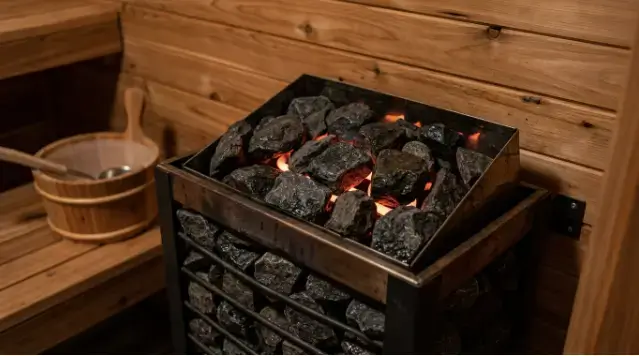
A compact backyard sauna, roughly 4 by 4 to 4 by 6 feet, generally pairs with a 4.5 kW electric heater mounted in a corner, on a dedicated 240-volt circuit run from the house or a nearby subpanel. The heater is the single biggest factor in whether a small footprint actually works, since undersizing it for the room leaves the space slow to heat and oversizing it wastes both money and available floor area that a small yard cannot spare.
How Much Space Does a Heater Actually Need?
Most home electric heaters ship in a compact housing designed for corner or wall mounting, typically taking up less than two square feet of floor footprint once clearance is factored in. The real space cost is not the unit itself but the mandatory clearance around it: a guard rail or rock guard sits a few inches from the nearest bench and wall, and that gap cannot be closed to save room. In a 4-by-4 cabin, planning the heater into a corner from the start, rather than trying to fit it in after the bench layout is set, is what keeps a small design from feeling cramped once the door and bench are both in place.
What Size Heater Actually Fits a Small Backyard Cabin?
The standard sizing rule is about 1 kW per 45 to 50 cubic feet of all-wood interior, with roughly 20 percent added if a wall or the door has glass. A 4-by-4 cabin with a 7-foot ceiling works out to around 112 cubic feet, which comfortably suits a 4.5 kW heater even with a glass door. Stretch that to a 4-by-6 layout for two people and the volume climbs to roughly 168 cubic feet, still usually within range of a 4.5 to 6 kW unit depending on window area. Going bigger than the room calls for wastes power and, in a small yard, often forces the heater closer to the bench than the clearance spec allows.
What Electrical Work Does a Small Cabin Actually Require?
Heaters in the 4.5 to 6 kW range typical of compact backyard units need a dedicated 240-volt circuit sized to the load, which in practice means an electrician running new wire from the panel and installing a properly rated breaker, generally in the 30 to 40 amp range depending on the specific heater. The distance from the house’s electrical panel to the backyard cabin matters more in a small-lot situation than people expect, since a longer run can require heavier gauge wire to avoid voltage drop. Getting a firm quote on that run before committing to a heater size avoids the common surprise of a compact cabin costing more to wire than it did to build.
Where Should the Heater Actually Sit in a Tight Layout?
Corner placement is the standard answer for small cabins because it keeps the unit out of the direct path between the door and the bench, which matters more in a 4-by-4 footprint than a larger room where there is slack to spare. Placing the heater under the bench is common in larger builds but usually is not workable in a compact design without violating clearance to the seating surface above it. A control panel mounted just outside the door, rather than only on the unit itself, also helps in tight cabins by letting someone start warming the room before stepping inside a small, already-hot space.
Does Rock Load Change for a Smaller Heater?
Smaller heaters in the 4.5 kW range still call for a real stone load, typically 40 to 50 pounds of sauna-grade rock, loaded loosely enough that air moves through the bed rather than packed tight. Skipping or skimping on stones to save space is a mistake, since the rocks are what let the heater hold heat and produce steam; a heater running with too few stones cycles on and off more, which shortens element life over time. In a small cabin, the stone tray is usually integrated tightly into the heater housing, so there is little practical space savings to be had by underloading it anyway.
Does Ventilation Matter More in a Small Cabin?
Yes, proportionally. A small, well-sealed cabin heats up fast, but it also needs the same basic intake-and-exhaust venting as a larger room, usually a low intake vent near the heater and a higher exhaust vent on the opposite wall, to keep air moving and prevent the space from feeling stale during longer sessions. Skipping proper venting to preserve wall space is a common shortcut in compact builds, and it tends to show up as an uncomfortable, heavy-feeling room rather than an outright hazard. A vendor listing that specifies venting requirements alongside heater wattage is worth more than one that only lists the heater spec in isolation, and a source such as sweatdecks.com/collections/sauna-heaters alongside a few other specialty retailers is a reasonable place to compare how different compact heaters handle sizing and airflow guidance together.
What Do Reviews of Small Sauna Setups Actually Show?
A 2018 review in Mayo Clinic Proceedings and a 2023 follow-up review in the same journal both summarize sauna research broadly without distinguishing cabin size, since the underlying studies were built around access to a sauna, not square footage. That means the cardiovascular associations reported in the literature apply just as much to a small backyard cabin used consistently as to a larger multi-person room, which is a reasonable point in favor of a compact build for someone with limited yard space rather than a compromise. Consistency of use, which a small, easy-to-heat cabin tends to support, matters more in the data than room size ever does.
See also: Strengthen Your Business Online Poiuytrewqazsxdcfvgbhnjmkl Web Experts
Frequently Asked Questions
What is the smallest sauna heater setup that still works well? A one- or two-person cabin around 4 by 4 to 4 by 6 feet typically pairs with a 4.5 kW electric heater in a corner mount, leaving room for the bench and door swing.
Does a small sauna heater still need 240 volts? Most 4.5 to 6 kW heaters for compact cabins need a dedicated 240-volt circuit. Only very small infrared or under-2-kW panel systems typically run on 120 volts.
How much clearance does a heater need in a tight cabin? Manufacturers specify a minimum guard clearance, commonly a few inches on the sides and more in front. Treat that spec as fixed even when floor space is tight.
Where should the heater go in a small backyard cabin? Corner placement is standard, keeping the unit out of the walking path between door and bench while meeting clearance on both adjacent walls.
References
- Cardiovascular and Other Health Benefits of Sauna Bathing: A Review of the Evidence, Mayo Clinic Proceedings, 2018
- Does the Combination of Finnish Sauna Bathing and Other Lifestyle Factors Confer Additional Health Benefits? A Review of the Evidence, Mayo Clinic Proceedings, 2023
- Effects of heat and cold on health, with special reference to Finnish sauna bathing, American Journal of Physiology, 2018
By Nathan Pruitt
